The roof leak over the laundry room that started at the gutter
Where water shows up inside a house is rarely where it got in.
October 20, 2026 · 4 min read
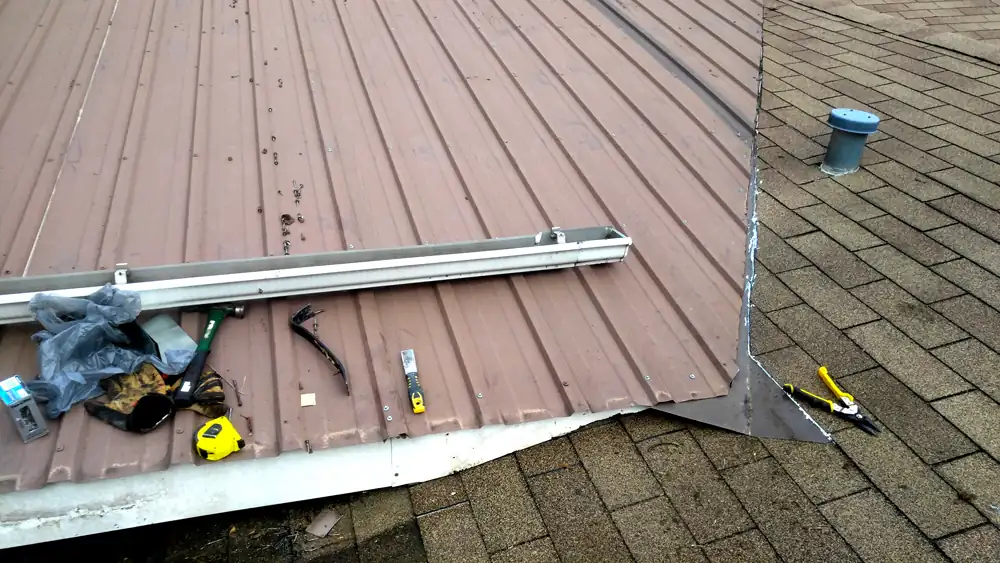
When a ceiling leaks, everybody looks up and blames the roof. Sometimes that's right. Sometimes the roof is just where the water was standing when it found a way in. One of John Blakemore's roof repairs was the second kind: a long-term leak over a laundry room that had been blamed on the shingles, and turned out to be a gutter pointed the wrong way.
What the leak looked like from inside
The homeowner had a leak that had been going on for a long time. It showed up in the laundry room, which is a bad place for it, because a laundry room already deals with moisture, lint, and warm air. A little extra dampness can hide for months in a room like that. People get used to a stain, or paint over it, or put a bucket down, and the real problem keeps going above the ceiling.
Leaks that run for a long time rarely stay a stain. Water that keeps soaking the same area softens whatever it touches. On this house, the roof sheathing had deteriorated by the time John traced the water back. Sheathing is the plywood or boards under the shingles, and it's what everything else is nailed to. Once it starts to rot, replacing shingles alone just covers a soft spot.
Following the water backward
The trick with a roof leak is to stop thinking about where you see the water and start thinking about where it could travel from. Water runs down a surface, along a rafter, or across a board before it drips. The wet spot on a ceiling can sit several feet from the opening that let it in.
In this case, the trouble sat at a junction where a metal roof section meets the shingles. That's already a spot that deserves attention, because two different roofing materials meet there and have to shed water into the right place. And the gutter below it was the trouble. It had been pitched back toward the shingle roof instead of away from it. Instead of carrying water off the house, it held water and dumped it right where the metal and the shingles meet.
That's a quiet kind of failure. The roof surface might be in decent shape, and the shingles might look fine from the yard. But if a gutter sends water back at the roof edge every time it rains, the wood below it never gets a chance to dry out. Over time the water finds the seams.
The repair, in the order it was done
Fixing the symptom would have meant a patch and a hope. John fixed the cause first. He re-pitched the gutter so it falls away from the roof and toward a drain, and added a new downspout so the water has somewhere to go. A gutter only works if it slopes toward the downspout, even slightly, and if nothing in its path holds water back.
Then he dealt with what the water had already ruined. The deteriorated sheathing came out and was replaced with new material, so the roof had solid wood to attach to again. After that, he rebuilt the valley using leftover shingles from the job. A valley is where two roof slopes meet, and it carries a lot of water, so it's one of the places where a repair has to be done carefully. Using leftover shingles kept the repair matching the rest of the roof, with no mismatched patch showing from the street.
The order matters. Re-pitching the gutter before rebuilding the roof meant the new work wasn't going to get soaked by the same problem next week. If you do it the other way around, you can build a good repair and watch it fail.
How to check your own gutters
You can spot a lot from the ground. Watch the gutters during a good rain, or run a hose along the roof edge, and see where the water goes. Look for these signs:
- Water pooling in the gutter instead of moving toward the downspout.
- Gutters that hang lower at the end farthest from the downspout, or visibly sag in the middle.
- Streaks or stains on the fascia and the wall behind the gutter.
- Water spilling over the front lip while the back stays dry, or the reverse.
- Dark, soft, or peeling boards at the roof edge.
If you see any of those near a place where the inside of your house has a stain, they're connected more often than people expect. A fascia board in bad shape is another sign. John has also replaced fascia on a house with 38 feet of continuous gutter, working at heights of 12 to 20 feet, and the first step there was the same: take the gutter down and see what's behind it.
When it's worth getting a second set of eyes
A leak that has been there a long time deserves an honest look, not a quick patch. If you've been drying a stain on a ceiling for more than one season, or you've re-caulked something and the water came back, that's the pattern. The longer the water has been at it, the more likely wood has to be replaced, and the cheaper way to find out is to have someone trace it properly.
John has spent a lifetime in residential and commercial construction, and he starts by finding where the water comes from. If you've got a stubborn leak, a sagging gutter, or a stain you've learned to ignore, call or text John at 865-978-0489. Estimates are free, and his labor is guaranteed for a year.
I'm Your Handyman Knoxville, 865-978-0489
Call 865-978-0489More articles
Fix small plumbing leaks before they spread
Most flooded bathrooms started as a drip that somebody meant to get to.
Choosing LED color temperature and a dimmer for old fluorescent fixtures
The fixture matters less than two numbers on the box: the K rating and the dimmer it's paired with.